
The Woman Who Turned a Needle into a Voice: Rukma Chetan’s Journey in Rural Sindh
To prove that even in a village where women have little control over their lives, Rukma Chetan is using her skills to be able to feed her family, to teach other women and to lead her community.
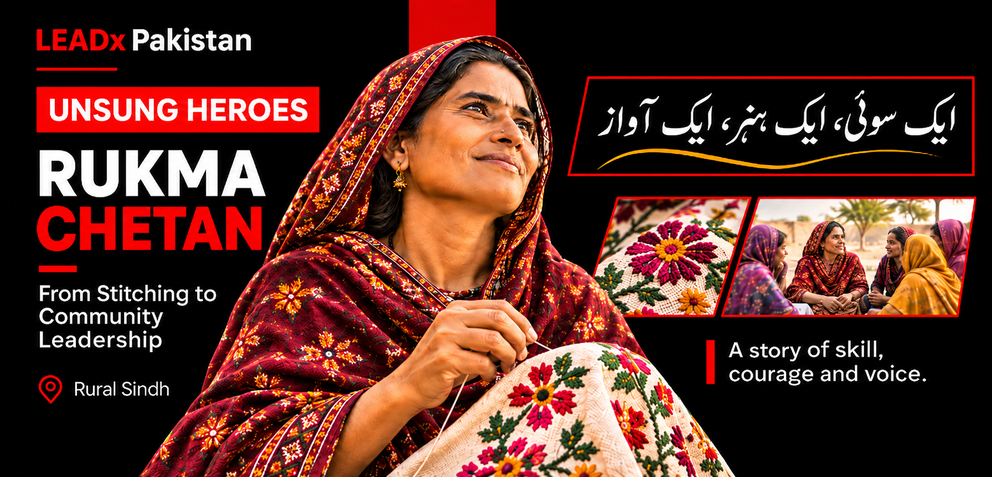
Rukma Chetan was 15 years old and wanted to continue going to school after completing her 9th grade. Life had other plans for her. She was married off to a 12 years older man and was never to return to school again.
Rukma hails from the remote, rural village of Shadman Jarwar situated in Tando Allahyar district of Sindh. Her parents were a couple who toiled hard as tenant farmers on other people’s land, for poverty had been Rukma’s constant companion throughout her childhood. In the starkly patriarchal setup of her village, girls were expected to fulfill the conventional roles of a homemaker, assist their mothers in household chores and work in the family’s fields. Men ruled the roost and took all important decisions pertaining to the family.
After Rukma Chetan got married she tried to convince her husband to let her return to school. Her husband however rejected her request, saying the villagers wouldn’t approve of it. And so Rukma Chetan’s unfinished education was put on hold, but she began to educate her children to secure their future.
Finding opportunity in difficult circumstances
Rukma and her husband have four children. He works on the farms of others as a laborer for hardly any wages. Sometimes there is not even enough to eat for the children.
Rukma knew that her husband’s income from laboring on other people’s farms would not be enough to sustain her and her family of four children. She was going to use the skills that she had acquired doing embroidery and stitching at home to earn some more money and also teach other village women the same skills for a weekly sum of Rs. 200 each.
For Rs. 200/week each of the trainees were giving Rukma a second income and also helping other women of the village to earn for their households by means of a skill that they had learned.
She didn’t hold any position at that time but what she did was enough for someone to call her a leader because she recognized the value in what she knew and distributed it to others.
The turning point: Finding a collective voice
Programs have been established in the village of Rukma through National Rural Support Programme (NRSP) since 2016 under the Sindh Union Council and Community Economic Strengthening Support (SUCCESS) Programme funded by the European Union. The purpose of the program is to organize rural women into community organizations and provide them with small loans and livelihoods support to generate income for their families.
When the National Rural Support Programme (NRSP) announced its implementation in Rukma’s village under the Sindh Union Council and Community Economic Strengthening Support (SUCCESS) Programme with funding from the European Union, Rukma was extremely excited to join however her husband as well as few other village members opposed her.
While other rural women attended meetings of their newly-formed community organizations – soon to form a lively community organization called Tanzeem – for discussion of problems of their community and ways & means to address these problems.
In watching other women of the community attend meetings to discuss and to work together to address problems affecting them and their children, Rukma finally found the courage to approach her husband and to obtain his permission for her to join. Eventually she became a member of the Tanzeem and attended meetings of the community organization.
To have a voice in decisions which affect her and her children’s education, was a total new change for Rukma. She was able to express herself in all matters that concerned her and contribute to decide upon issues affecting her and her children.
From personal progress to community leadership
Having joined the organization, Rukma also gained a means to increase her economic potential through the Community Investment Fund, a community-managed fund that makes very small loans to the very poor. Rukma borrowed Rs. 15,000 to purchase a goat, with the intention of raising it and then selling it for around Rs. 22,000.
By 2018, when NRSP compiled her case study for ‘Voices from the Field’, Rukma was President of her Village Organisation, made up of all the community organisations in her village. In addition to earning about Rs. 6,000 per month from her work as a Community Resource Person in another development program, Rukma was also earning money from her tailoring work. Her husband was now very supportive of her work in the village, after having first been opposed to her involvement.
Rukma’s activities extended far beyond her household. A woman who was denied the chance to receive an education encouraged children in her village, especially girls, to go to school. “In my society, people don’t educate their girls, but now this trend has started changing,” she said. As a leader of her Village Organisation, Rukma also participated in debates on possible solutions for the problem of the lack of clean drinking water in her village.
What Rukma’s journey teaches us
A practical skill, an income and group membership are key to women’s empowerment. Teaching embroidery enabled Rukma to earn money and others to acquire skills. Community organization provided Rukma with the confidence to demand a voice in decision making within her local community.
However, Rukma’s progress wasn’t in isolation. A group of women in her village organized first and the resources of NRSP and the SUCCESS Programme were also poured in. So while individual determination is important, there’s so much more to it when there are opportunities provided.
The majority of women’s leadership in rural Pakistan starts within the home of the leader before they are given a title. Rukma’s ability to speak publically today to represent her entire village to ensure her community becomes independent and can work together to achieve their goals started with the skills she gained as a girl to earn enough to put food on her children’s plates. She then used the same skill to earn enough money to enable other women to earn a living too.
She never got the chance to go back to school but today she represents her whole village. She wants her community to be independent and working in each other’s best interests.
Cover picture
(opens the full-size picture in a new tab)
Comments
No comments yet. Start the conversation.