
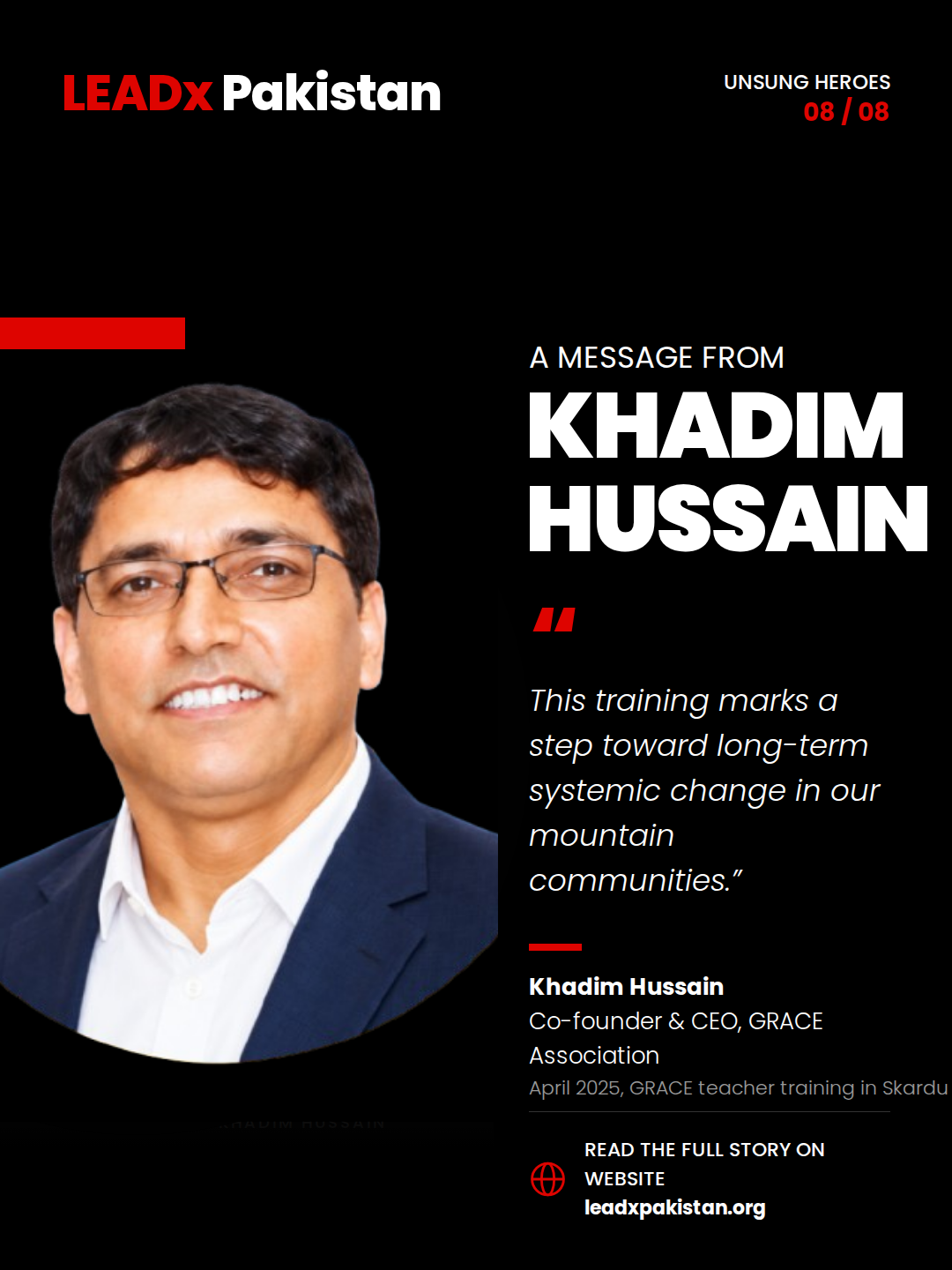
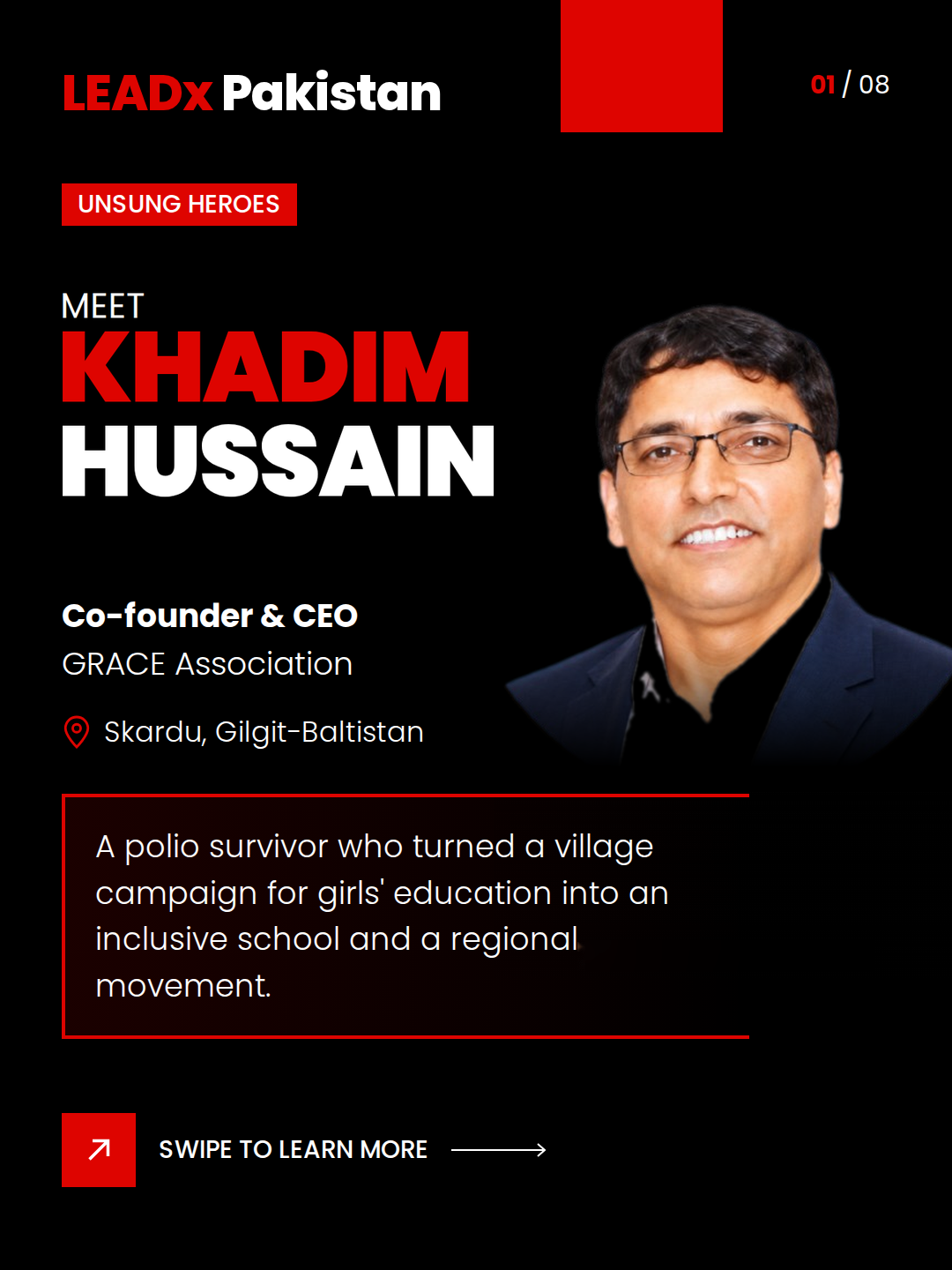
Khadim Hussain
A boy who got inspired by his sister. He and his friends built the first girl's school in their village in northern Pakistan.
A boy was born in a remote village in the mountains of northern Pakistan. At the age of one, the boy caught polio and lost all his functions in his lower limbs. According to the beliefs of many communities of the village that disability is a punishment from god, his parents also had the same belief. The young boy had a great desire for knowledge and education, because of this he wanted to go to school. However, his parents did not let him go to school because of his disability. Seeing his passion for knowledge and education, his friends helped him a lot in achieving his passion. His school was six kilometers away from his town, his friends carried him each day and everyday to school in a wheelbarrow.
In the remote village, not only disabled children but young girls were also not allowed to go school, It was considered a sin. Extreme poverty also prevented parents from letting their daughters go to school. People of the village only allowed the boys to join school, so that they would earn for their family in the future. Whereas, girls were kept at home because the villagers thought that girls would become the property of other families once they got married. Government schools were built more for boys than for girls, in some communities the ratio was 10 to 1.
Khadim Hussain had a sister, her name was Zubeda. She also had a desire for education like most of the other girls of the village. One day, she asked her brother, Khadim, to teach her Urdu alphabets. Seeing his sister’s desire for education, he wanted to teach her. However, his parents stopped him from teaching his sister as it was considered a sin and against islamic teachings for girls to read school books and to get education. At this moment, Khadim realised this was a major problem in his village. Within weeks, Khadim and his friends made a plan to solve this problem and improve the education system in his village. They went door to door urging parents to send their boys to school, there was no girls school at that time, so parents never considered sending their daughters to school. Khadim found an adult who could read and write. He and his friends asked him if he would teach girls and they promised they would pay him and other teachers from their own pocket money for teaching girls.
Village’s first girls school was made and within a year 22 girls started attending the school including Zubeda. For the next several years, Khadim carried out rallies in support of education for girls in his village. Because of this awareness, many villagers' minds were changed that once showed resilience for girls' education. Later his father donated land for the school building and found a donor who donated for construction of the school. Because of Khadim’s support Zubeda continued her education. Today Zubeda is teaching in her village school.
Khadim Hussain himself holds a Master’s degree in economics from University of Punjab. He has completed advanced certification from Aga Khan University, World Bank Institute, the Brookings institution, and Childhood Education International. He is also a Google certified project management professional. He has also built an organisation, is CEO and cofounder of GRACE Association. Since 1992, he has worked as a teacher, principle and development practitioner, he cofounded GRACE school in Skardu for girls. As a member of the school's Board of Governors, he provides strategic direction, policy oversight, performance evaluation, financial accountability and strong academic outcomes.
Cover picture
(opens the full-size picture in a new tab)
About Amama Hussain
Meet Amama, a BS English student with a growing passion for storytelling and writing. As a story writer, she is exploring the art of turning real-life experiences, emotions, and everyday moments into meaningful stories. Her interest in English literature helps her understand different perspectives and the experiences that shape people's lives. She believes everyone has a story worth telling and hopes to grow as a writer by learning, observing, and sharing stories that readers can relate to.
Comments
No comments yet. Start the conversation.