
The Blue of Multan: Can a Centuries-Old Craft Find Its Future?
Multan’s blue pottery is not only a treasure of artistic heritage but also a symbol of the hardships faced by the artisans who create it, whether to adorn the historic shrines of Multan or to decorate homes and interiors around the world.
A Colour That Defines a City
Blue, the colour of Multan, holds a treasure of artistic heritage from the past. The city’s beautiful historic shrines are decorated with this masterpiece of fine craftsmanship.
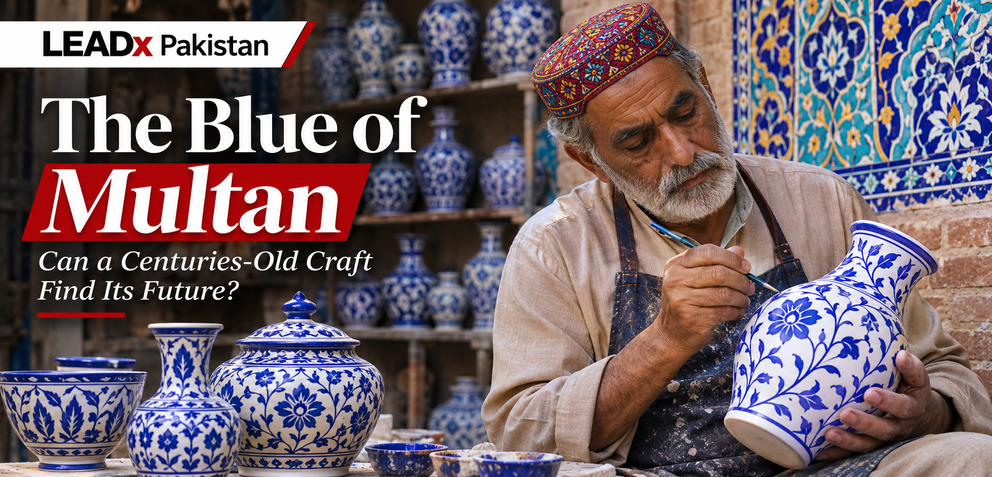
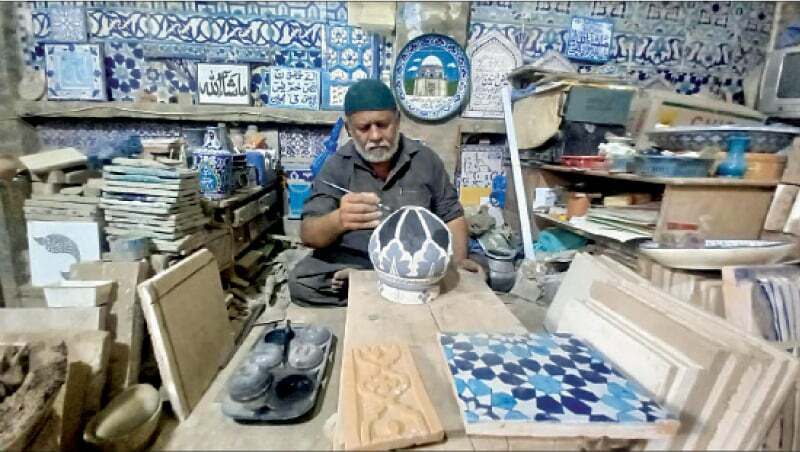
A simple ball of clay passes through the hands of an experienced artisan to be shaped, dried, fired, decorated with intricate designs and finally glazed. Each piece goes through several stages of handcrafted preparation and is fired at about 1,200 degrees Celsius in the final stage.
Each piece of Multani pottery that leaves a workshop today carries knowledge passed down through generations of skilled artisans. Yet the people who make it struggle to earn a living. Can Multani pottery survive as a viable livelihood in the 21st century?
The Art Behind Multan's Identity
Multan is famous far beyond Pakistan for its blue pottery. Rooted in the Persian tradition of kashi kari, or glazed tilework, the craft has been developed over generations by local artisans. Much of the work is made to decorate buildings such as shrines, tombs and mosques. It is mostly done in cobalt blue, turquoise and white, in floral designs, geometric motifs and borders. The blue colour comes from cobalt oxide and the green from copper oxide.
The magnificent tilework on the tomb of Shah Rukn-e-Alam, some seven centuries old, along with that on the tombs of Hazrat Bahauddin Zakariya and Shah Shams, belongs to this tradition.
For the families of blue pottery workers, the craft means income, creativity and identity. For generations, skilled artisans have learned its intricate skills through the traditional ustad–shagird (master–apprentice) method, learning from their masters just as those masters had learned from theirs.
An artisan needs to know the different types of clay and how to mix colours in the correct proportions. Each piece must be fired at the right temperature to get the right finish. These skills are not easily learned; they take years of practice, patience and understanding of materials.
When Heritage Becomes Difficult to Afford
Multani pottery is widely admired, but in recent years the cost of producing it has been rising.
The prices of raw materials, energy and utilities are increasing, and the craft also faces shrinking demand at home and limited opportunities to export. According to a report by the Associated Press of Pakistan (APP), most of the clay is brought from distant areas such as Tharparkar, Swat and Quetta, and setting up a new pottery unit requires an investment of at least Rs 5 million.
“Making blue pottery is not an easy task. It needs proper training and dedication,” master craftsman Allah Rakha told APP.
Most small workshops find it difficult to increase production, buy new equipment or compete with cheaply made decorative goods, both at home and abroad.
Many young people prefer other jobs that they feel pay better. Unless those who learn the craft can earn a living from it, the skills of generations of artisans may be lost.
Finding New Possibilities
Although Multan’s blue pottery still needs support to develop and survive, opportunities for both are being created in the city.
Punjab’s Technical Education and Vocational Training Authority (TEVTA) has set up the Institute of Blue Pottery Development in Multan. Since 2006, the institute has offered training in kashigari, mould making, casting and ceramic firing. According to APP, around 100 students were enrolled in 2025. The institute also provides scholarships and shared facilities for local producers, and is researching lower-cost raw materials.
This effort will also enable the city’s youth to learn the art and help them find new ways to make it commercially viable.
Some ceramic artists are also combining the region’s traditional techniques with contemporary practice. Multan-based ceramic artist Muhammad Nauman Mirza trained under Multan’s renowned pottery masters in kashigari and naqashi, and now blends these crafts with contemporary ceramic work. His work has been exhibited in Pakistan, China and the UK.
By presenting heritage practices within the framework of contemporary art, artists such as Mirza allow wider audiences to appreciate a heritage that might otherwise remain limited to a niche audience.
Can Multan's Blue Reach the World?
This cultural heritage can become part of Pakistan’s creative economy, supporting employment and small businesses for talented Pakistani craftspeople in markets around the world.
Industry experts say, however, that beautiful products alone are not enough. To succeed in the global export market for handmade goods, handicrafts need stronger branding, better packaging and consistent quality.
Such steps could help Multan’s blue pottery reach its full potential in the global market for creative goods, and ensure that local artisans receive a fair return for their work. Preserving the tradition and showcasing local skills are important, but if the craft does not bring artisans an income, it makes little difference to their lives.
More Than a Beautiful Tradition
Intricately painted blue tiles have adorned the historic shrines of Multan for centuries. Their repeating patterns are a testament to the city’s valuable contribution to the world of art.
It is crucial to distinguish between preserving the past and sustaining a living tradition. Multan’s historic buildings can be restored, and its blue pottery can be exhibited in museums. But the knowledge and skills needed to create such masterpieces will be lost if the next generations of artisans no longer practise them.
Multan has no shortage of art or history. What its pottery industry needs is a future. The blue of Multan can decorate the city’s monuments for centuries to come, but making sure it also provides a decent living for the artisans who create it is a different challenge altogether.
Cover picture
(opens the full-size picture in a new tab)

Comments
No comments yet. Start the conversation.